As a culture that is completely separated from the production of our commodities, it is difficult to see the reality of how and where our money is spent. The harsh truth of our money reaching far beyond the counter of transaction in which we receive the product is not new. Outsourced labor in countries far from our own with poor conditions, to workers in our own countries suffering from poor working conditions, our commodities are not created in a vacuum. There are heinous results of poor treatment of workers in this world that are way beyond the scope of this writing. I am choosing a more personal (fitting as this is a blog) dilemma in my own sphere: Video Game Production.
Video Games are not a niche hobby, played in the basements of disapproving parents’ homes. This multi-billion-dollar business is at the height of never-ending peaks and thresholds it decides to break each year. Games are an integral part of entertainment, culture, the economy, and are at an all-time high in the current zeitgeist. Games injected a sense of identity for multiple generations of people, as well as how those generations spend their money, interact with media, and furthermore, how they are choosing to produce in a culture and economy they helped create.
A little detour down how big the industry is…
It’s fair to say that along with the massive growth in industry, gone are the days of bedroom coders creating experiences for us to enjoy. Passion projects that people put their blood, sweat, and tears into. Of course, that labor of love has not ceased, it is just further separated from those coders and artists’ hands.
Ten companies comprise 65% of the total revenue produced in the video games industry last year (https://www.gamesindustry.biz/report-top-10-companies-made-65-percent-of-global-games-market-in-2021).
Some of these companies are the face of some of our most prized memories. Nintendo, Sony, Microsoft; all having major footholds in the console and PC markets the past couple of decades, and the producer of so many amazing games. Of course, the studios making most of those games are not in the same echelon of recognition. For every Activision Blizzard and Rockstar Games, there are thousands of smaller studios making games under the umbrella of much larger corporations. The benefits for the smaller studios of course are immense. Their games published by these larger studios are reaching far more people than what they potentially would have if they chose the independent route. See Devolver Digital (https://www.devolverdigital.com/about) for how this model doesn’t have to be predatory and also massively beneficial for independent studios trying to get their games played by the people who make the dang things for: us.
Many times, a larger studio like EA, can provide resources that are unimaginable for an independent studio. Exposure, talent/experience, and technology to name just a few. Take it from one of those smaller developers Velan Studio (Knockout City), who’s CEO Karthik Bala said this in an interview with GamesBeat,
“They’ve provided feedback on builds of the game when we’ve asked for it,” Bala told GamesBeat. “We’ve been able to take advantage of EA’s user testing process, ability to run private and public betas, which was absolutely crucial, and some of the infrastructure pieces such as the EA ID account system, which gave us a way to implementing seamless crossplay/cross-progression on Day 1. The Knockout City team at Velan is about 50 developers, and we built the game engine and a lot of the networking tech from scratch. But to get to scale and launch globally on so many platforms, we needed that support from EA.”
https://venturebeat.com/games/ea-originals-shows-the-value-of-smaller-games-for-big-publishers/
Of course, this relationship isn’t just benefitting the small studio. In the case of another EA published game, It Takes Two, developed by Hazelight studios, a game that has surpassed 5 million copies sold (https://gamerant.com/it-takes-two-5-million-copies-sold/), EA gets a massive piece of those profits all along with the great publicity of the game winning multiple awards, including Game of the Year at The Game Awards. EA is a massive studio that is at the butt of many insults and scathing reviews from the community. A company that has little but no good will after the recent release of Battlefield 2042 earlier this year. Oh, and who can forget, this tweet…
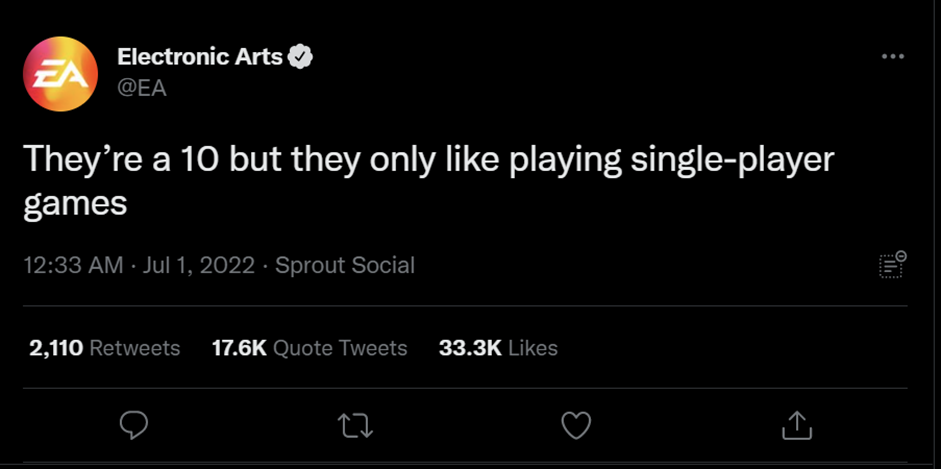
But…they publish these great indie games also, remember? They contribute to the art. So, all is well. Never mind the years of class-action lawsuits against the company for, and not limited to, unfair working conditions, unpaid overtime work, and more recently good ol’ loot boxes. There’s so many references and further readings of these, but the Wikipedia page Criticism of Electronic Arts is a good place to start (https://en.wikipedia.org/wiki/Criticism_of_Electronic_Arts).
The Dilemma
Great, who cares. The industry is damn big and big studios use small studios to get richer. Sounds a lot like industry not just the videogame industry. There are so many examples of bad companies making and publishing some of our favorite games, that have terrible work conditions, and are run by monsters. Shout out Bobby Kotick of Activision Blizzard fame.
This is all to say, when we buy games, we are not just supporting the art of making video games, but the companies that create, support, and farm some of the tumultuous environments in which our favorite experiences are created.
So, where is the line? We know the industry has problems. Do we just stop playing games all together? Do we only buy games from companies with perfect track-records? What about the thousands upon thousands of developers and artists who are innocent and victim to these terrible conditions? Without our support, many of them would not have jobs. Customers buying games is what employs the people who work in the gaming industry in the future. And without them, we’d have no more games!
Hellena Taylor, voice actor of Bayonetta fame, is asking us to face this dilemma face on. In a recent twitter thread, the massively accomplished voice actor, posted a multi-part video explaining the situation of being offered an “insulting” amount of money to once again be the voice of Bayonetta in the much-anticipated Bayonetta 3 out on Oct 28th.
Taylor’s actual case against the company and the validity of the statements are again very much out of the scope of this blog post. Being a mere outsider on the situation I can only hear her message and feel for the situation of her, and so many other underpaid and under-valued people that work so hard to make experiences enjoyable for us.
The question in the video posited I think is very interesting for the Video Game Industry as a whole. Hellena Taylor is very bluntly asking the fans of the series to not buy the game. In fact, boycott the game (https://kotaku.com/bayonetta-3-hellena-taylor-voice-nintendo-switch-hale-1849662631).
Is it time gamers support the game industry folks with their dollars? Or rather, lack thereof. How can boycotting an industry help the workers?
I don’t think it’s very far-fetched to think that many others feel the same as me in that, knowing that people have suffered through the making of games that I love after I have played them sours the experience. Right now, workers in the games industry are speaking up during the production process. Attempting to unionize their workplace and advocate for further efforts in the growing labor movement were seeing in the industry (https://www.polygon.com/23270642/union-video-game-industry-qa-activision-blizzard-keywords). The result of this kind of action is putting the consumer directly in the line of sight of some of the glaring problems of this massive industry. It’s easy to see video games as a thing we do to pass the time, as with much of the commodities we enjoy.
Consumers have a choice of how and where to spend their money. But we know, year after year as Activision Blizzard releases another Call of Duty, people are going to buy it. What would a boycott really help? Does the average consumer really see this massive effort that workers in the industry are going through? Big companies are pretty good at mitigating bad press and keeping the image of their IP as commercially viable facing as possible. Call of Duty Vanguard, developed by Activision Blizzard, at the height of horrible press, middling reviews (for a COD game), and a rising collected consciousness of the labor movement, was still the best-selling new video game of 2021. Sure, below their expectations, but nonetheless, a hit. (https://www.washingtonpost.com/video-games/2021/12/03/raven-software-layoffs/)
It’s hard to say if boycotting certain games would in fact change the entirety of how the industry operated. If it did work, it wouldn’t be an overnight shift. If we as consumer’s truly held the line, boycotted game after game released by “bad” companies, it would result in massive layoffs around the industry. Detrimental to say the least for the workers we are trying to support. That’s the dilemma, isn’t it? Where do we draw the line of being fans of games and advocates for systemic change within the games industry?